41 labels in assembly language examples
Assembly - Loops - Tutorials Point Assembly - Loops. The JMP instruction can be used for implementing loops. For example, the following code snippet can be used for executing the loop-body 10 times. The processor instruction set, however, includes a group of loop instructions for implementing iteration. The basic LOOP instruction has the following syntax −. Assembly Language Programming • ECEn 323: Computer Organization Assembly language is more readable than the binary machine code and is easier to edit and manipulate. The purpose of the "assembler" is to translate the text assembly language file written by a human into binary machine code executed by the processor (See section 2.12 in the textbook). This process is tedious and best left to a computer.
Jumping to Labels in Inline Assembly | Microsoft Docs Assembly instructions can jump to a C or C++ label without regard to case. Don't use C library function names as labels in __asm blocks. For instance, you might be tempted to use exit as a label, as follows: Because exit is the name of a C library function, this code might cause a jump to the exit function instead of to the desired location.

Labels in assembly language examples
Labels (x86 Assembly Language Reference Manual) - Oracle When a numeric label is used as a reference (as an instruction operand, for example), the suffixes b ("backward") or f ("forward") should be added to the numeric label. For numeric label N, the reference Nb refers to the nearest label N defined before the reference, and the reference Nf refers to the nearest label N defined after the reference. 2 Assembly Language Programming - University of New Mexico In an assembly language program, a label is simply a name for an address. For example, given the declarations shown in Example 2.1, ``x'' is a name for the address of a memory location that was initialized to 23. On the SPARC an address is a 32-bit value. As such, labels are 32-bit values when they are used in assembly language programs. What are Labels in assembly language? - Quora Answer (1 of 3): It has been a while since I have used Assembly Language and terminology has a way of causing confusion, but I will try to explain. The Machine Language of Computers really only has 2 Binary Identities, it is either an Instruction or it is Data.
Labels in assembly language examples. What Is Assembly Language (With an Example) | Indeed.com In this example, "1:" is the label, which lets the computer know where to begin the operation. The "MOV" and "ADD" is the mnemonic command to move the number 3 into a part of the computer processor where it can function as a variable. "EAX," "EBX" and "ECX" are the variables. The first line of code loads 3 into the register "eax." SECTION V-10: Rules for Labels in Assembly Language By choosing label names that are meaningful, a programmer can make a program much easier to read and maintain. There are several rules that names must follow. First, each label name must be unique. The names used for labels in assembly language programming consist of alphabetic letters in both upper and lower case, the digits 0 through 9, and the special characters question mark (?), period (.), at (@), underline (_), and a dollar sign ($). PDF Chapter 2 HCS12 Assembly Language - TTU CAE Network A line of an assembly program Label field ... 2.1 Assembly language program structure 2.2 Arithmetic instructions 2.3 Branch and loop instructions ... Example: Write a program to add two 4-byte numbers that are stored at $1000-$1003 and $1004-$1007, and store the sum at $1010-$1013. Learning Assembly Language | Codementor Typically examples are telling the assembler that the following instructions are code (usually via a .text directive) vs. data (usually via a .data directive). Like regular instructions, these instructions are typically written on their own line, however, the inform the assembler rather than generate machine code instructions directly.
8051 - "Label" in Assembly language - Stack Overflow "Label" in Assembly language Ask Question 1 I have couple of examples which are pretty simple except LABEL concept. Example 1 adds 25 10 times in itself, whereas example 2 takes complement of Register A 700 times. assembly - How does the 'label' keyword work in MASM? - Stack Overflow The someName label word statement assigns the current address (of type word) to someName. This means that later in the program, you can use the label someName instead of a specific address. The dw statement reserves some amount of space of type word. I'm not entirely certain what the 8dup (0) means, but it might be 8 words (16 bytes) of space. Assembly - Label | Assembly | Datacadamia - Data and Co Grammar - Label in Assembly. A label is a name given to an addresses. Without the programmer would be required to manually calculate them. It's used to identify a target address storing: a instruction for a branch instruction (ie the value of the target address is executed) data (ie the value of target address is used as data in an operation) PDF Graded ARM assembly language Examples - AlanClements Graded ARM assembly language Examples These examples have been created to help students with the basics of Keil's ARM development system. ... Anything starting in column 1 (in this case Stop) is a label that can be used to refer to that line. 4. The instruction Stop B Stop means 'Branch to the line labelled Stop' and is used to create an ...
PDF Lecture 5 Basic Elements of Assembly Language Data Labels : a data label identifies the location of a variable, providing a convenient way to reference the variable in code. The following, for example, defines a variable named count: count DWORD 100 The assembler assigns a numeric address to each label. It is possible to define multiple data items following a label. Assembly Language Syntax by Valvano Examples. Assembly Language Syntax Programs written in assembly language consist of a sequence of source statements. Each source statement consists of a sequence of ASCII characters ending with a carriage return. Each source statement may include up to four fields: a label, an operation (instruction mnemonic or assembler directive), an operand ... Assembly language - Wikipedia Assembly language usually has one statement per machine instruction (1:1), but constants, comments, assembler directives, [5] symbolic labels of, e.g., memory locations, registers, and macros [6] [1] are generally also supported. Assembly code is converted into executable machine code by a utility program referred to as an assembler. PDF Assembly Language Programming - UTEP - Labels are symbols - Labels must begin in column 1. - A label can optionally be followed by a colon - The value of a label is the current value of the Location Counter (address within program) - A label on a line by itself is a valid statement - Labels used locally within a file must be unique. Adapted from notes from BYU ECE124 5
Programming Xpert
PDF Assembly Language - University of Texas at Austin NOW, Under21, R2D2, and C3PO are all examples of possible LC-3bassembly language labels. There are two reasons for explicitly referring to a memory location. 1. The location contains the target of a branch instruction (for example, AGAIN in line 0E). 2.

Assembly Language Lecture no 03 Register types - YouTube
Example of label in assembly language - Australia ... Apr 25, 2022 · X86 Assembly/Control Flow. as for example cmp Introduction to 8086 Assembly Language An example Label Mnemonic Operand Comment Input and Output Using 8086 Assembly Language. example: REG, memory zWhen there are two operands, both operands must have the same size label 4-byte address segment second value is an offset (this is a far
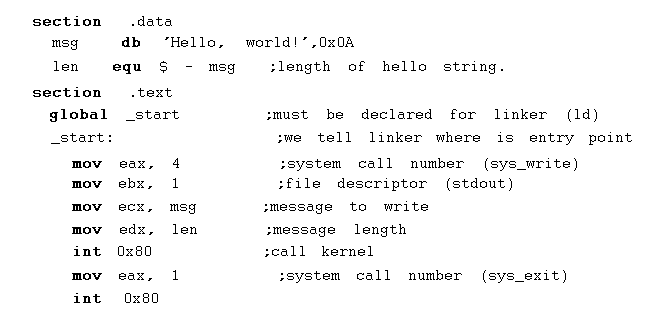
NASM Installation
Local Labels - Elements of Assembly Language Here are some examples of legal identifiers: Grab Hold Widget Pot_of_Message MAXNAME A numeric label consists of a digit (0 to 9) followed by a colon. As in the case of alphanumeric labels, a numeric label assigns the current value of the location counter to the symbol.

Introducing: Assembly Label – NZ Fashion Blog | Mode.co.nz
pic microcontroller assembly language programming examples For example MOVLW is an Opcode. Labels. A label is an identifier used to represent a line in code or section of a program. Goto statements can be used in conjunction with a Label to jump to the execution of code identified by the particular label. See Task 1 code for example. ... pic microcontroller assembly language examples 6.

PDF Assembly Language: Overview - Princeton University Jump and Labels: While Loop! while (n>1) { } Checking if EDX is less than or equal to 1. 28 movl %edx, %eax andl $1, %eax je else jmp endif else: endif: ... • Read more assembly-language examples! • Chapter 3 of Bryant and OʼHallaron book! • Generate your own assembly-language code! • gcc217 -S -O2 code.c!

Another example for Assembly Language to Machine Language Code using Symbol, Literal and Base ...
Embedded Systems - Assembly Language - Tutorials Point The names used for labels in assembly language programming consist of alphabetic letters in both uppercase and lowercase, number 0 through 9, and special characters such as question mark (?), period (.), at the rate @, underscore (_), and dollar ($). The first character should be in alphabetical character; it cannot be a number.
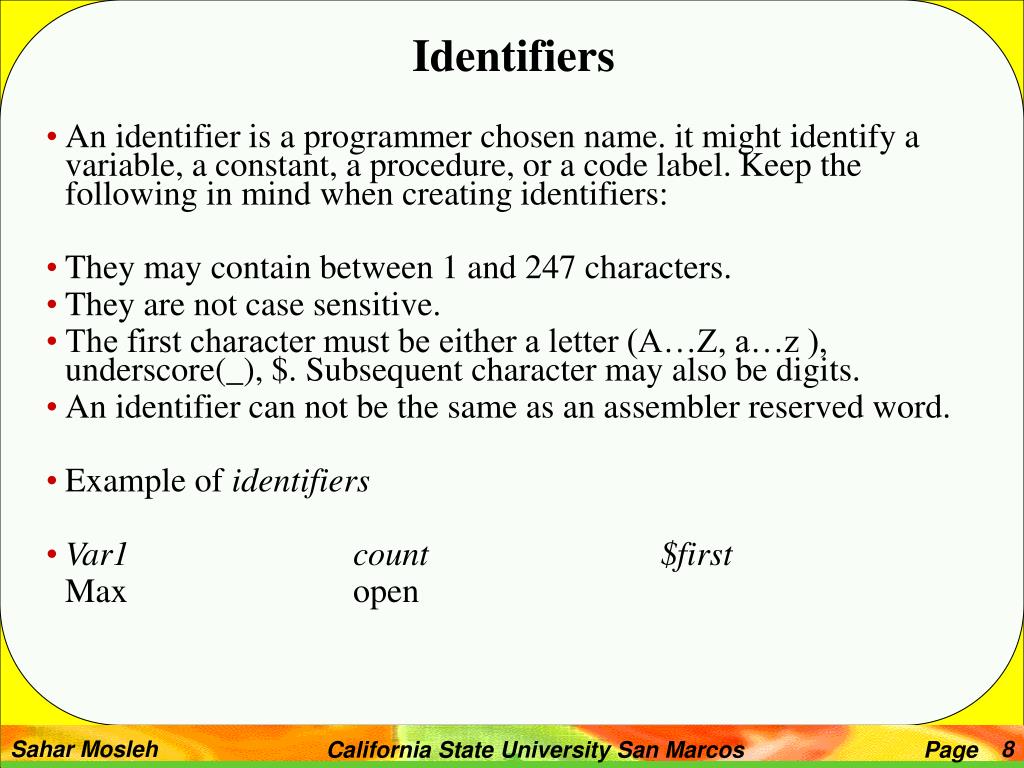
PPT - Introduction to Assembly language Data Definition Reserve words Labels Instruction ...
What are Labels in assembly language? - Quora The label is in fact a shorthand for skipping the manual calculation of the number of bytes to add to or subtract from the index pointer, for jump to label means just setting the new place in the memory the execution should continue at, ip+ or - some value.
Assembly Label Registration and Sign Up Information | assemblylabel | Register Check
Example of Assembly - University of Aberdeen The directive EQU stands for "equals"; it allows you to give a numerical value to a label. In this example, the assembler would always replace START with 1016. Hence you could write : START EQU 10 ORG START GOTO 10 The assembler would translate START as 10, and load the code at $10, as before.

grace: Sam Rainsy Seeking Return With Elections on the Horizon Sam Rainsy, who is currently in ...
Label (computer science) - Wikipedia In assembly language labels can be used anywhere an address can (for example, as the operand of a JMP or MOV instruction). Also in Pascal and its derived variations. Some languages, such as Fortran and BASIC, support numeric labels. Labels are also used to identify an entry point into a compiled sequence of statements (e.g., during debugging ).

part7
PDF LC3 Assembly Manual and Examples - Georgetown University The above listing is a typical hello world program written in LC-3 assembly language. The program outputs "Hello World!" to the console and quits. We will now look at the composition of this program. Lines 1 and 2 of the program are comments. LC-3 uses the semi-colon to denote the beginning
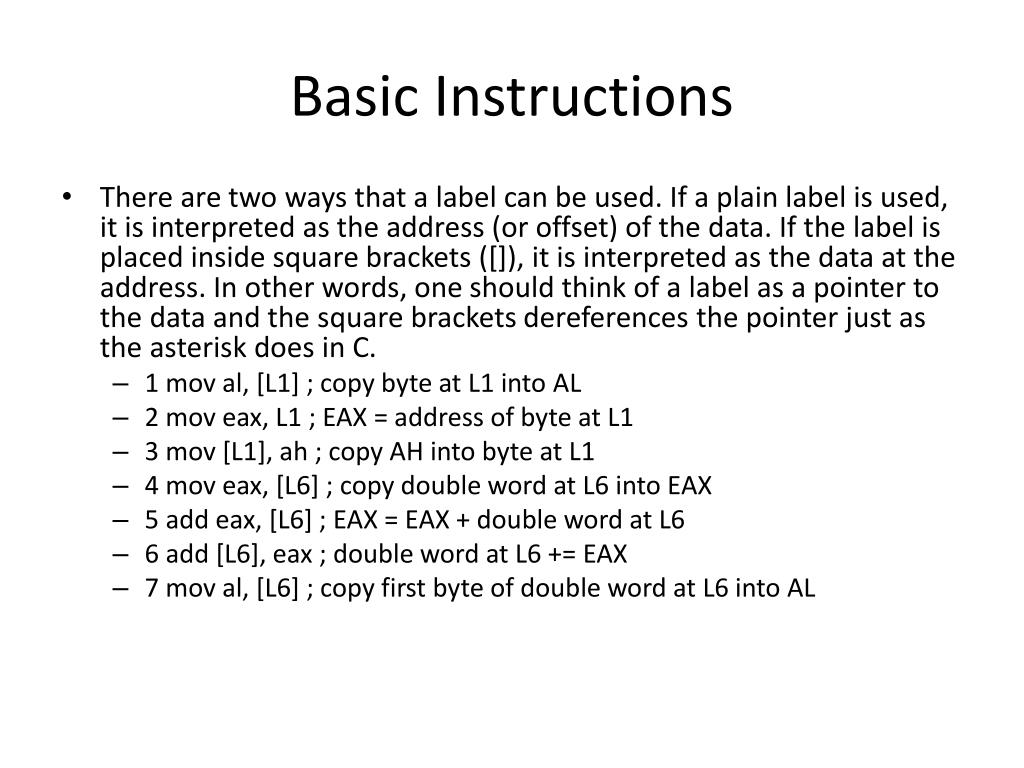
PPT - Elements of Assembly Language PowerPoint Presentation - ID:2280712
LC3 Assembly Language.ipynb - Bryn Mawr College The assembler first goes through the source code collecting labels, and their locations. During the second pass, it can substitute the used label in the operands with the label location minus instruction location - 1. .ORIG x4000 x4000 LD R1, SIX x4001 HALT x4002 SIX: .FILL #23 .END. So, the PC-offset for SIX is x4002 - x4000 - 1 = 1.
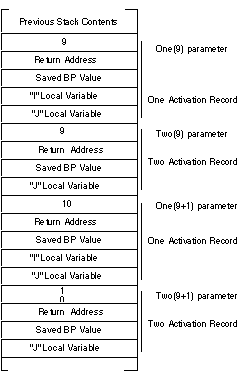
Art of Assembly Language: Chapter Twelve-2
PDF Chapter 3 Assembly Language Fundamentals Assembly language instructions can have between zero and three operands, each of which can be a register, memory operand, constant expression, or I/O port. ... • constant expression: ex. 10 * 10 • register: ex. eax • memory (data label): ex. count Examples of assembly language instructions having varying numbers of operands • No ...
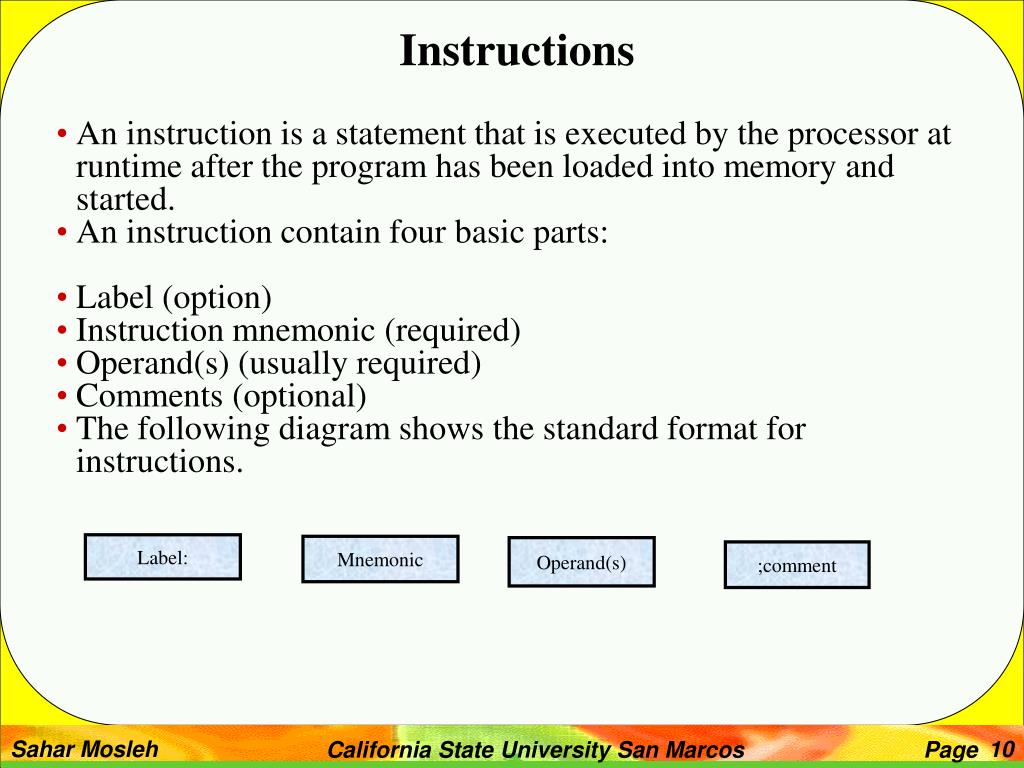
PPT - Introduction to Assembly language Data Definition Reserve words Labels Instruction ...
What are Labels in assembly language? - Quora Answer (1 of 3): It has been a while since I have used Assembly Language and terminology has a way of causing confusion, but I will try to explain. The Machine Language of Computers really only has 2 Binary Identities, it is either an Instruction or it is Data.

Labels and Branching | Assembly Language Tutorial | Part 5 - YouTube
2 Assembly Language Programming - University of New Mexico In an assembly language program, a label is simply a name for an address. For example, given the declarations shown in Example 2.1, ``x'' is a name for the address of a memory location that was initialized to 23. On the SPARC an address is a 32-bit value. As such, labels are 32-bit values when they are used in assembly language programs.
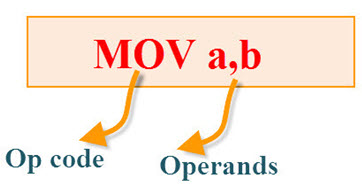
Know Assembly Language Programming of 8086
Labels (x86 Assembly Language Reference Manual) - Oracle When a numeric label is used as a reference (as an instruction operand, for example), the suffixes b ("backward") or f ("forward") should be added to the numeric label. For numeric label N, the reference Nb refers to the nearest label N defined before the reference, and the reference Nf refers to the nearest label N defined after the reference.

Assembly Language Study Resources
PALASM_2_Software_Jul87 PALASM 2 Software Jul87
Post a Comment for "41 labels in assembly language examples"